
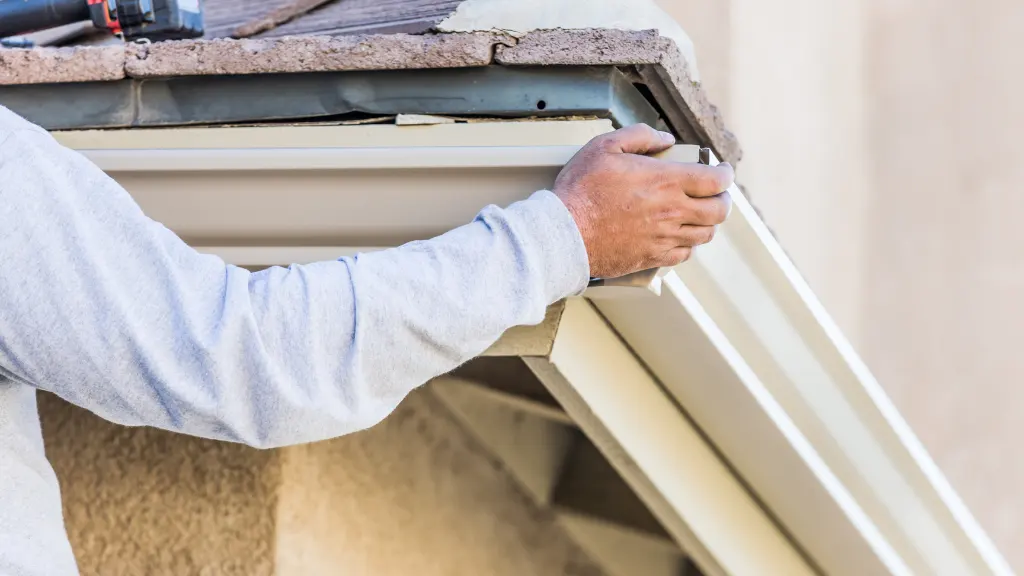
Gutters rarely get attention until something goes wrong. Yet this simple gutter system quietly works to protect your home from water damage, channeling water away from your house and its foundation, siding, roofline, and landscaping. Like every part of your roofing system, gutters have a finite lifespan — and knowing when it’s time to replace your gutters can save you thousands of dollars in repairs.
So, how often should gutters be replaced? The short answer: anywhere from 20 to 30+ years depending on the material — with the aluminum gutters found on most American homes lasting around 20 to 30 years. But the more useful answer is that gutters should be replaced when their condition says so, not when the calendar does. Material, installation quality, climate, and maintenance all determine where your system falls within that range — so let’s take a closer look at each.
How Long Do Gutters Last? Lifespan by Material
The single biggest factor in the lifespan of gutters is the material. Here is what you can realistically expect from each type:
Aluminum Gutters: 20–30 Years
Aluminum is the most popular gutter material in the United States, and for good reason. It is lightweight, rust-resistant, affordable, and available as seamless gutters. With proper maintenance, aluminum gutters typically last 20 to 30 years. In harsher climates with heavy snow or frequent storms, expect the lower end of that range.
Vinyl Gutters: 10–20 Years
Vinyl is the budget-friendly option, but it comes with trade-offs. Vinyl gutters might become brittle in cold climates and warp in extreme heat. In mild regions, vinyl gutters can last up to 20 years; in areas with temperature extremes, 10 to 15 years is more realistic.
Galvanized Steel Gutters: 20–25 Years
Steel gutters are stronger than aluminum and handle heavy snow loads well. However, galvanized steel is prone to rust once its protective zinc coating wears away, which usually limits its lifespan to about 20 to 25 years.
Copper Gutters: 50+ Years
Copper is the premium choice. It does not rust, develops an attractive patina over time, and copper gutters can last 50 years or more — sometimes up to a century with excellent care. The trade-off is cost: copper systems are significantly more expensive to purchase and install.
Zinc Gutters: 40–50 Years
Zinc offers durability similar to copper at a somewhat lower price point. These systems can last 40 to 50 years and self-heal minor scratches through their natural patina.
Factors That Shorten (or Extend) the Life of Your Gutters
Two identical gutter systems can age very differently depending on the conditions they face. When it comes to gutter longevity, these are the variables that matter most:
1. Climate and Weather Exposure
Homes in regions with heavy rainfall, frequent freeze-thaw cycles, hail, or intense sun will see gutters wear out faster. Ice dams in winter are particularly damaging — the weight of ice can leave gutters pulling away from the fascia and warp the channels.
2. Maintenance Habits
This is the factor every homeowner controls most directly. Clogged gutters hold standing water, which accelerates corrosion, adds weight that strains hangers, and leads to overflowing gutters that damage siding and fascia. Cleaning your gutters at least twice a year — typically in spring and fall — can add years to their service life. If you need to clean more often because of nearby trees, solutions like gutter guards can help.
3. Installation Quality
A poor gutter installation — improperly pitched runs, undersized downspouts, or too few hangers — will cause premature failure no matter how good the material is. Gutters should slope roughly a quarter inch for every 10 feet toward the downspouts to drain properly.
4. Surrounding Trees
Overhanging branches drop leaves, twigs, and seed pods directly into the channel, causing gutters to clog repeatedly. Homes surrounded by mature trees often experience shorter gutter lifespans unless the owners keep the gutters free of debris.
5. Seamless vs. Sectional Design
Seamless gutters, fabricated on-site in continuous runs, have far fewer joints — and joints are where most leaks begin. A seamed gutter system, joined every few feet, tends to develop leaks earlier and requires more frequent gutter repair.
When Is It Time to Replace Your Gutters?
For most homeowners, gutter replacement is not a recurring chore — it’s something you’ll do only once or twice over the entire time you own your home. If you buy a house with a five-year-old aluminum system and maintain it well, you may not think about replacement for another two decades.
That said, “how often” is better answered by condition than by the calendar. Gutters don’t fail on a fixed schedule; they fail when accumulated wear crosses a threshold. A well-maintained system in a mild climate can outlive its expected range, while a neglected one in a storm-prone region may need replacement in half the time. This is why professionals recommend treating gutter replacement as an inspection-driven decision rather than an age-driven one.
A practical way to think about it:
- Years 0–10: Replacement is rarely needed. Focus on cleaning and minor repairs.
- Years 10–20: Start inspecting more closely each season. Isolated issues can still be repaired, but budget for eventual replacement.
- Beyond year 20: Evaluate the system as a whole every year. Once repairs become repetitive, replacement is usually the more economical path.
The other timing trigger is your roof. Since gutters and roofing age together and share labor costs during installation, many homeowners simply align gutter replacement with their roof replacement cycle — which naturally lands in a similar 20-to-30-year window.
8 Signs That Your Gutters Need to Be Replaced
Age alone does not tell the full story. If you suspect your gutters are failing, look at your gutters for these signs of damage — clear indicators that it’s time for new gutters:
- Visible cracks or splits. Small cracks grow larger with every freeze-thaw cycle. A few isolated cracks can be sealed; widespread cracking is a sign it’s time to replace the system.
- Rust spots or orange discoloration. On steel gutters, rust signals that the protective coating has failed. Once corrosion starts, it spreads.
- Gutters are sagging or pulling away from the house. Gutters that sag or detach from the fascia can no longer channel water correctly. If multiple sections are sagging or pulling away, the system is likely failing.
- Peeling paint or water stains on siding. Vertical streaks or bubbling paint beneath the gutter line indicate chronic overflow or leaks behind the gutter.
- Pools of water or erosion near the foundation. If water is collecting outside your home after rain, your gutters are not carrying water away from your home — and your foundation is at risk.
- Separated gutters or split seams. Sections that repeatedly split at the seams, even after resealing, are telling you replacement is necessary.
- Nails or screws on the ground. Fasteners working loose from the fascia suggest your current gutters are straining under weight or the wood behind them is deteriorating.
- Basement moisture or flooding. Persistent dampness in the basement often traces back to failed gutters and downspouts directing water toward the foundation instead of away from it. If basement flooding appears after storms, replace gutters quickly before the damage spreads.
If you notice one or two of these issues in isolated spots, targeted repairs may be enough. If several signs appear across the whole system — or the gutters reach the end of their lifespan — full gutter replacement is usually the smarter investment.
If you’re unsure whether repair or replacement is the right choice, the experts at Chicago Gutter Repair can inspect your gutter system and recommend the most effective solution to protect your home.
Gutter Repair or Replacement? How to Decide
A useful rule of thumb: if the cost to replace a few sections repeatedly approaches 50% of the price of new gutters, or if you keep fixing the same problems, replacement makes better financial sense.
Repair makes sense when:
- The gutters are relatively young for their material
- Damage is limited to one or two sections
- The issue is a loose hanger, a small leak, or a single sagging run
Replacement makes sense when:
- The system is at or beyond the age gutters should last
- Cracks, rust, or sagging appear in multiple areas
- You are dealing with recurring leaks despite past repairs
- Water damage is showing up on siding, fascia, or the foundation
Also consider timing your project with other work: if you plan to get a new roof, a combined roof and gutter project often saves labor costs, since a roof replacement is the best time to replace gutters as well.
How to Extend How Long Your Gutters Last
Whether your gutters are brand new or a decade old, these habits will maximize their lifespan:
- Clean and check your gutters at least twice a year, and more often if trees overhang your roof.
- Install gutter guards to reduce debris buildup and cleaning frequency.
- Inspect your gutters after major storms for dents, loose hangers, or separated seams — a quick inspection takes minutes and prevents bigger problems.
- Reseal minor leaks promptly before they widen.
- Keep downspouts clear and ensure they discharge water away from the foundation, at least four to six feet out.
- Trim overhanging branches to reduce debris and prevent impact damage.
- Check the pitch periodically — standing water in the channel means the slope needs adjustment.
The Bottom Line: Know When to Replace
Most homeowners will need their gutters replaced every 20 to 30 years with aluminum or steel, while copper and zinc systems can last half a century or more. But the calendar is only a guideline. Climate, tree cover, installation quality, and — above all — regular maintenance determine where your gutters fall within that range, and how often you should replace them.
The best approach is simple: inspect your gutters every spring and fall, address small problems quickly, and know when it’s time to act. When cracks, rust, sagging, and leaks tell you the gutters are done, do not wait for water damage to force the decision. Replacing old gutters and installing a quality new system is one of the most cost-effective ways to protect your home — the biggest investment you own.